

Heat Trace for Pipes, Tanks, and Valves
Pipe Freeze Protection and Process Temperature Maintenance
Recommended Systems, FAQs, Additional Services & Support
Pipe heat tracing systems are widely used in commercial buildings, industrial facilities, and outdoor infrastructure where exposed pipes are vulnerable to freezing temperatures or process temperature fluctuations. By installing the heating cable along the length of the pipe, the system generates controlled heat within the pipe and the fluid inside. This setup helps maintain the desired fluid temperature and prevents the pipes from freezing during cold weather conditions.
Different pipe heat tracing solutions may require different freeze protection strategies depending on the pipe location, fluid temperature requirements, and environmental conditions.
See what pipe heat trace we recommend for different applications:
Self-Regulating Pipe Heating Cables — The Ideal Solution
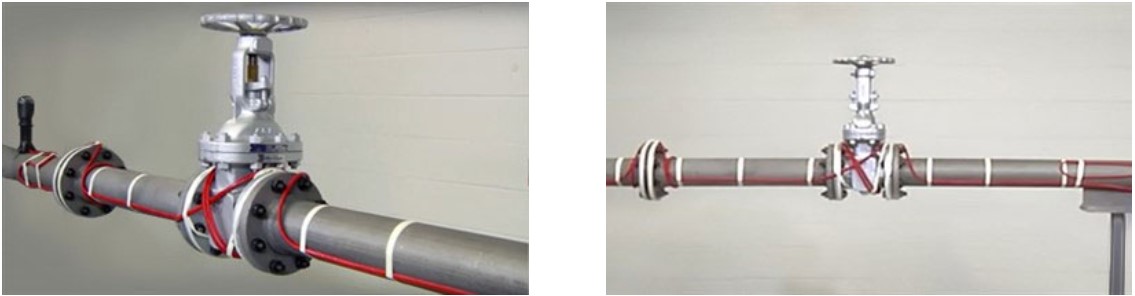
Self-regulating cables generate heat as the electrical current passes through the conductive polymer core between the cable’s conductors. As the ambient temperature drops, the number of electrical paths through the core increases, and more heat is produced. As the temperature rises, the core has fewer electrical paths, and less heat is produced. Self-regulating heat trace pipe cables are often preferred for freeze protection because they can reduce the risk of overheating and provide energy-efficient heating along varying pipe conditions.
At APPLIED TPG, we carry a selection of Raychem heat cables for pipes that include a radiation-crosslinked core to ensure long-term reliability. Each cable is also available in a wide range of watt outputs and voltages to accommodate project specifications.
Commercial Self-Regulating Pipe Heating Cable
Raychem XL-Trace Edge: This pipe heat trace system provides freeze protection for metal and plastic pipes and flow maintenance for grease disposal and fuel lines. It is simple to design and easy to install with cut-to-length capability and clear meter markings. Common applications include cooling towers, parking garages, coolers, freezers, and sprinkler systems.
Industrial Self-Regulating Pipe Heating Cables
Raychem BTV cables: This family of Raychem self-regulating pipe heating cables provides a great solution for freeze-protection and process-temperature maintenance applications. The pipe trace heating cables maintain process temperatures up to 150°F (66°C) and can withstand intermittent exposure to temperatures up to 185°F (85°C). They are suitable for installation in non-hazardous and classified hazardous areas, as well as environments where corrosive elements may be present.
QTVR heat trace cables: The QTVR family of Raychem pipe heating cables can provide process-temperature maintenance up to 225°F (107°C) and can also be used for freeze protection in systems having high heat loss. These heating cables are configured for use in non-hazardous and hazardous (classified) locations, including areas where corrosives may be present.
Raychem XTVR: These self-regulating pipe heating cables are ideal for applications requiring high power output. The heat trace cables can withstand temperatures up to 482°F (250°C) and provide process temperature maintenance to 302°F (150°C). They can be used in non-hazardous as well as hazardous (classified) locations where corrosives are present.
Raychem HTV: These self-regulating pipe heating cables are designed for high-temperature process maintenance applications. The heat trace cables can provide process-temperature maintenance up to 400°F (204°C) and can withstand exposure temperatures up to 500°F (260°C). They are suitable for use in non-hazardous as well as hazardous (classified) locations, including environments where corrosives may be present.
Non-Self Regulating Cables
Variable Power Limiting (VPL) heating cable: These pipe heat tracing systems are used for applications requiring high power output or applications that exceed the temperature ranges of self-regulating cables for pipes. VPL cables provide process-temperature maintenance up to 455°F and can withstand routine steam purges and temperature excursions to 500°F with power off. They are also approved for use in non-hazardous and hazardous locations.
Raychem XMI-A (Alloy, 825) electric heat trace cable: This pipe heat trace system is a metal sheathed, mineral-insulated (MI) cable often used when high-power output, high exposure temperatures, or extreme resistance to environmental corrosives are needed. It can provide up to 61 watts per foot (200 watts per meter) of power output with area classification and design approvals. The maximum maintain temperature for this electric heat cable is 1022°F (550°C) and the maximum exposure temperature is 1200°F (650°C).
>> Watch a step-by-step Raychem Industrial Heat Trace installation video
FAQs
What are common applications for pipe heat trace systems?
There are residential, industrial, and commercial pipe freeze protection systems commonly used for the following applications:
- Water supply lines and process piping
- Fire protection and sprinkler systems
- Fuel and oil transfer lines
- Chemical and process fluid piping
- Outdoor piping exposed to freezing conditions
Pipe heat tracing helps maintain flow, prevent freeze-related pipe damage, and support continuous operations in cold environments.
How does heat tracing work for pipes?
Pipe heat tracing systems use electric heating cables installed along piping systems to replace heat lost to the surrounding environment. The system helps maintain the temperature of fluids inside the pipe and is commonly used for pipe freeze protection or process temperature maintenance. By maintaining the pipe temperature above freezing, the system helps prevent ice formation inside the pipe.
Proper insulation and system design are important to ensure the heat trace system can maintain the required temperature during the lowest expected ambient conditions.
When is pipe heat tracing required?
Pipe heat tracing is commonly used when piping systems are exposed to ambient temperatures that could cause fluids to freeze or fall below required operating temperatures.
What types of heat trace cables for pipes are there?
Multiple types of heating cables may be used depending on the application, specifically the temperature requirements, pipe material, and environmental conditions.
Self-regulating pipe heating cables are commonly used for pipe freeze protection and moderate process temperatures. Power-limiting pipe heating systems are designed for higher temperature maintenance applications. Mineral-insulated pipe heat cables are used in high-temperature or demanding industrial environments.
Can pipe heat trace systems be installed on any type of pipe?
Pipe heat trace systems can typically be installed on many metal and plastic pipe types, but the system design must account for the pipe material, temperature limits, and insulation requirements. Certain applications may require specific cable types or installation methods to ensure safe operation.
Do pipe heat tracing systems require temperature controls?
Many heat trace systems for pipes use thermostats or temperature monitoring systems to control operation. These controls help ensure the heating cable operates only when needed and maintains the desired temperature range. In larger commercial or industrial systems, centralized monitoring and control systems may also be used.
How is a pipe heat tracing system designed?
Designing a heat trace system typically requires evaluating pipe diameter and length, fluid maintenance temperature, minimum ambient temperature, insulation thickness and type, electrical power availability, and hazardous or non-hazardous area classification.
Proper design helps ensure the system provides adequate heat while operating safely and efficiently. At APPLIED TPG, we can help with engineering heat trace design services. Contact us to learn more.
Additional Services
Whether you need help with system selection or are looking for more support, we want to help. At APPLIED Thermal Product Group, we have the expertise and resources to help with everything from design to field service support.
- Engineering Design Services
- Heat Trace Audits/System Assessments
- Site Walkdowns
- Field Service Support
Contact our team today for help with your next project.